Rodent control in Cumberland County requires addressing structural vulnerabilities created by regional architectural styles. Established homes in Haymount and Vanstory Hills frequently feature ventilated crawlspaces…
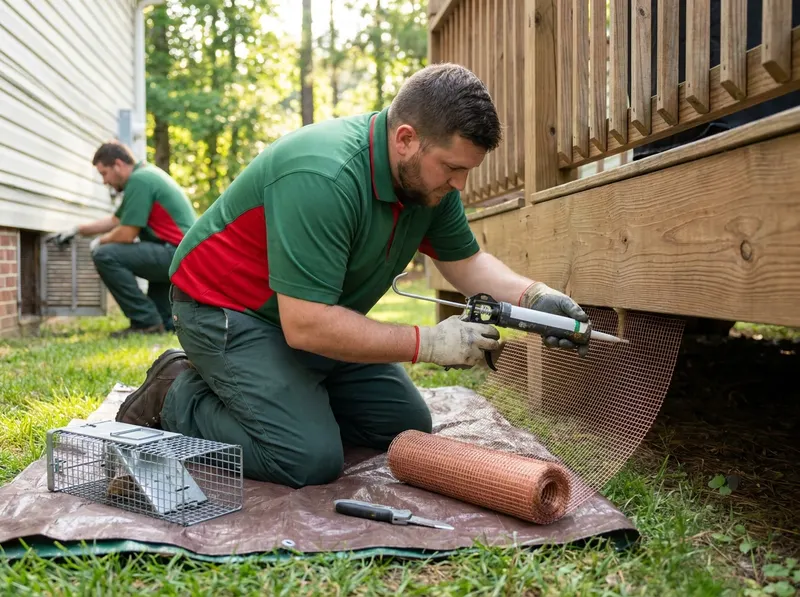
Rodent control in Cumberland County requires addressing structural vulnerabilities created by regional architectural styles. Established homes in Haymount and Vanstory Hills frequently feature ventilated crawlspaces and aged stone foundations where settlement leaves gaps exceeding one-quarter inch. Roof rats exploit loblolly pine branches overhanging shingles in Buckhead, Kingsford, and Terry Sanford, entering attics through unmeshed soffit returns and ridge vents. Traditional broadcast baiting introduces significant risks, as poisoned rodents frequently die inside inaccessible drywall voids or subfloors, producing severe odor issues and fly infestations. Precision mechanical trapping captures active specimens immediately without leaving toxins accessible to household dogs or cats.
Structural exclusion stops the cycle of rodent entry by removing the access pathways that store-bought snap traps and bait stations leave open. Technicians seal foundation vents, pipe penetrations, and AC line-set chases in neighborhoods like Montclair, Cottonade, and Arran Hills using 19-gauge quarter-inch galvanized steel mesh bonded with metal-reinforced sealants that rodents cannot gnaw through. For slab-foundation residences in Rayconda and the Jack Britt school district, garage door bottom sweeps, corner trim gaps, and dryer exhaust vents are the primary mechanical entry points targeted during installation.
The field-tested execution follows a reliable sequential procedure. Step 1: Technicians conduct a complete crawlspace, attic, and exterior perimeter audit to identify runways, droppings, sebum rub marks, and entry points. Step 2: The structural exterior is sealed up to roofline level, blocking all pathways down to 0.25 inches. Step 3: Trapping stations are calibrated and set along interior travel lanes away from children and pets. Step 4: Follow-up checks are executed at 3-to-5-day intervals to empty traps, reset arrays, and verify that no fresh activity bypasses the physical exterior barriers.
Every job gets a firm, written price after a free on-site visit.
Tell us about your rodent trapping and structural exclusion job in Fayetteville and we'll send a clear, written quote, usually the same day.
 Praxeno Pest Solutions