Exterior perimeter defense prevents outdoor foraging columns from turning into kitchen and crawl space invasions. In Cumberland County, warm temperatures and sandy-loam soils allow red imported fire ants and Argentine…
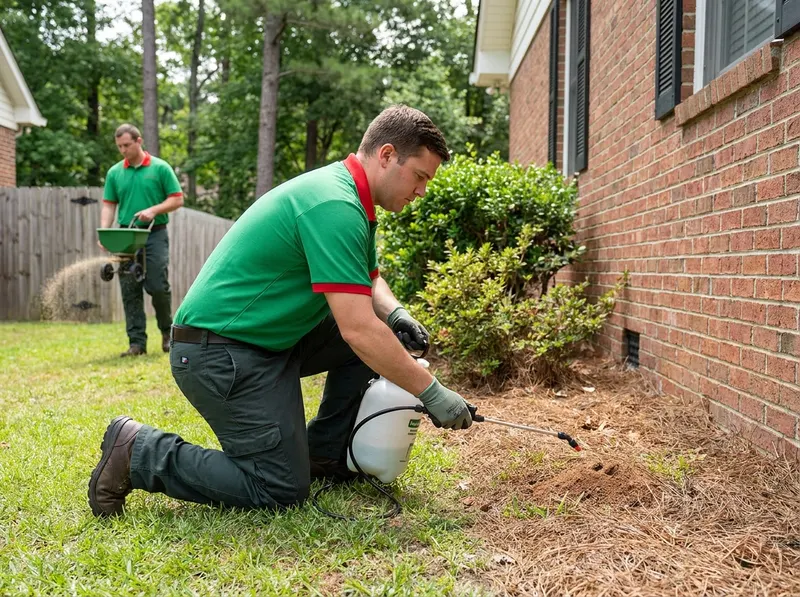
Exterior perimeter defense prevents outdoor foraging columns from turning into kitchen and crawl space invasions. In Cumberland County, warm temperatures and sandy-loam soils allow red imported fire ants and Argentine ants to form extensive underground networks. In established tree-lined areas like Haymount, Terry Sanford, and Vanstory Hills, mature roots and landscape pine straw create protected sub-surface nesting sites right against concrete slabs. When exterior colonies reach carrying capacity or experience heavy summer rains, worker ants follow plumbing lines, brick weepholes, and crawl space vents directly into living areas. Applying store-bought repellent sprays around baseboards inside merely splits these outdoor mega-colonies through budding, turning a single outdoor nest into three indoor satellite nests.
A dedicated exterior barrier eliminates this risk by intercepting worker ants outdoors where they nest and forage. Technicians apply a liquid non-repellent transfer product 36 inches up the vertical exterior foundation and 36 inches outward across the perimeter soil, mulch, or gravel. Foraging ants cross this treated zone undetected, picking up active microscopic particles and transferring them back to the subterranean queen during normal grooming routines. Active mounds scattered throughout lawn turf, frequently observed across open acreage in Jack Britt, Buckhead, and Rayconda, are treated independently with targeted mound injections or weather-resistant granular baits. This dual approach neutralizes the central reproductive queen while maintaining a protective boundary against re-infestation from adjacent properties.
Property size and soil conditions dictate the application volume required for lasting control. In neighborhoods such as Montclair, Arran Hills, Cottonade, and Kingsford, dense shrub beds or heavy mulch layers require higher liquid volume to penetrate down to the mineral soil line where root systems meet the slab. The process works in 3 clear steps: 1. Complete perimeter inspection mapping all visible mounds, satellite nests, and structural entry gaps around utility penetrations. 2. Targeted direct injection or precision bait distribution across turf-based fire ant mounds. 3. Continuous 3x3 perimeter residual barrier application around the entire home footprint. Treatments dry within 60 to 90 minutes, remaining stable against rain while keeping children and indoor pets safe from exposure.
Every job gets a firm, written price after a free on-site visit.
Tell us about your exterior ant mound and perimeter control job in Fayetteville and we'll send a clear, written quote, usually the same day.
 Praxeno Pest Solutions