Crawlspace vapor and pest defense is engineered to halt the chimney effect, in which humid ground air pulls upward through subfloors into primary residential spaces. In established Fayetteville neighborhoods like…
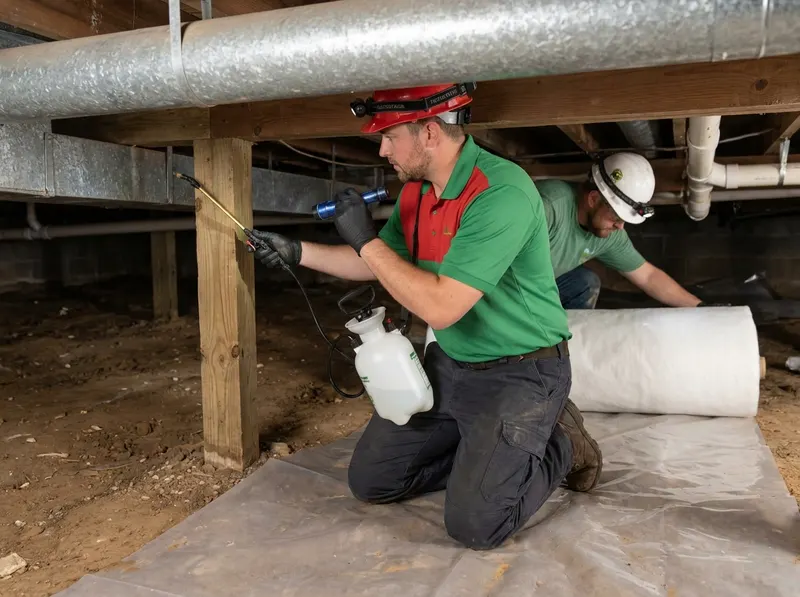
Crawlspace vapor and pest defense is engineered to halt the chimney effect, in which humid ground air pulls upward through subfloors into primary residential spaces. In established Fayetteville neighborhoods like Haymount, Terry Sanford, and Cottonade, crawlspaces built over sandy loam and clay retention basins routinely reach relative humidity levels above 70 percent. This sustained dampness softens pine framing and creates prime entry vectors for subterranean termites and wood-boring beetles. Installing a continuous 12-mil or 20-mil poly barrier over exposed dirt cuts ambient foundation moisture below the 19 percent wood-moisture threshold required for active wood-decay fungi, while targeted perimeter applications neutralize hidden colonies before they breach sill plates.
Selecting crawlspace defense balances ground moisture control against comprehensive encapsulation. Homes in higher elevations around Buckhead or Jack Britt often require a standard class-1 vapor retarder paired with boring-insect borate wood treatments, which stops surface pests without the installation cost of mechanical dehumidifiers. Conversely, low-lying parcels near the Cape Fear River basin or Montclair often show standing ground vapor and vent pooling; these structures require mechanical vent sealing, drainage corrections, and sealed crawlspace liners to prevent recurring infestations. Crawlspace encapsulation alters crawlspace ventilation, whereas standard vapor defense preserves natural foundation airflow while locking out soil-based insects.
1. Technicians complete an entry assessment across all foundation access points, recording wood moisture content using calibrated pin meters. 2. Debris, organic construction waste, and abandoned nesting materials are extracted to remove harborage food sources. 3. Wood joists, sill plates, and band boards receive a targeted liquid application of disodium octaborate tetrahydrate to deter structural pests. 4. Heavyweight vapor film is rolled, fitted around brick foundation piers, overlapping seams by 12 inches, and mechanically fastened. 5. Vent openings receive quarter-inch galvanized hardware cloth to halt rodent transit, finished with granular micro-encapsulated perimeter barriers.
Every job gets a firm, written price after a free on-site visit.
Tell us about your crawlspace vapor and pest defense job in Fayetteville and we'll send a clear, written quote, usually the same day.
 Praxeno Pest Solutions